Logo200.png)
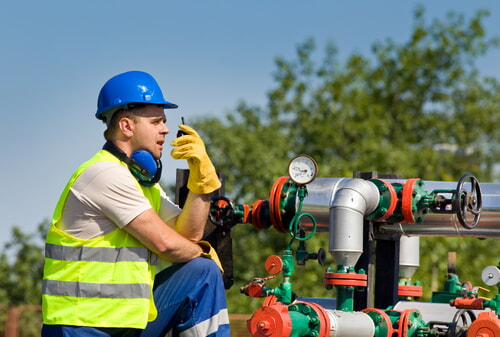
Oil Rig Safety Gear: PPE Worn Across On-Shore Drilling and Production Operations
One of the more dangerous occupations is drilling for oil and natural gas. From setting up riggings to reaching the final depth, there is a risk of injury. Workers have many different jobs when setting up and drilling on a rig, and each type of job has its own risk of injury. Wearing personal protective equipment (PPE) can significantly minimize those risks.
Phases of Drilling Operations
OSHA publishes safety recommendations for six phases of drilling, and each phase has several activities.
- Setup the substructure: Welding and cutting. Goggles, impact gloves, and welding clothing or flame-resistant clothing.
- Rig the floor setup: Swinging equipment. Hard hats, hi-vis clothing.
- Install handrails: Power and hand tools. Goggles and hi-vis clothing.
- Install the power system: Chemical hazards. Waterproof gloves and hi-vis clothing.
- Rig the circulating system: Hammer strikes. Impact gloves.
- Install auxiliary equipment: Tubular strikes. Impact gloves, hard hats, and hi-vis clothing.
- Inspect the rig: Eye hazards. Goggles, hard hats and hi-vis clothing.
- Handling pipes: Pipe strikes. Impact gloves, hard hats, and hi-vis clothing.
- Prepare drilling fluid: Exposure to chemicals and explosions. Waterproof gloves, hi-vis clothing, and flame-resistant clothing.
- Begin drilling: Tong, chain and pipe strikes when these items are swinging through the air. Impact gloves, hi-vis clothing, hard hats.
- Break out pipe: Pinched fingers. Impact gloves.
- Making up pipe: Struck by the Kelly or spinning chains. Hard hats, goggles, hi-vis clothing.
- Raising the Kelly: Struck by the Kelly, debris and / or overhead objects. Hard hats, goggles, hi-vis clothing.
- Adding pipe: Being struck by swinging pipe. Hard hats, hi-vis clothing, impact gloves.
- Drilling: Eye hazards. Goggles.
- Coring: The core strikes or pinches workers. Hi-vis clothing, hard hats, impact gloves.
- Setting slips: Pinched fingers. Impact gloves or puncture-resistant gloves.
- Setting back the Kelly: Release the excess drilling mud.
- Elevator attachment and latching elevators: Pinched by the elevator and catching the hands between the stump and elevator: Impact-resistant gloves.
- Monkeyboard work: Caught between the pipes and other objects. Hi-vis clothing.
- Breaking out pipe and moving pipe to the racking area: Caught between pipes, tongs and slip handles could strike you. Hi-vis clothing, impact-resistant gloves, hard hats.
- Tripping in: Catching hands between the stump and elevator.
Rigging Up
Placing the rig and getting it ready for drilling has several steps:
Drilling Ahead
Many hazards exist, including flash fires. The activities during this phase include:
Tripping Out and In
This process involves removing the pipe from the well to replace a bit or other equipment. Steps include:
Other Jobs in On-Shore and Drilling Operations
Other jobs and activities on a rig include the casing operation, which is lining the well hole with a pipe that is larger than the drilling pipe. In addition to the above incidents, high-pressure lines could strike workers.
Maintenance activities include several activities, including line maintenance, rope maintenance, circulating mud, working with engines and maintaining the derrick. Injuries are similar to those above, plus workers could sustain chemical burns, injuries from flash burns and thermal burns.
Controlling the well involves maintaining the pressure to prevent a blowout and maintaining the surface control system. The activities involved have some of the same hazards as previously mentioned.
Personal Protective Equipment at Abolox for Rig Workers
Abolox carries all the personal protective equipment you need, regardless of your position in on-shore drilling and production operations. Browse through our pages to select the PPE you need. If you don’t see what you need, call the store, and we’ll source the personal protective equipment you need.
