Logo200.png)
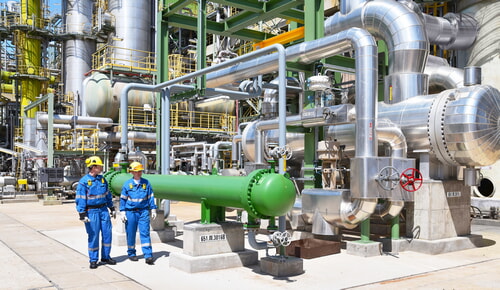
Oil and Gas Refining Industry
The refining industry is a downstream industry in the oil and gas industry. Companies in the refining industry manufacture, refine and market oil, natural gas, and other petroleum products from crude oil.
Some of the key companies in the refining industry include Exxon Mobile, Chevron, Marathon, Mobile, BP, ConocoPhillips, Andeavor, and Carlisle. Independent refineries include Suncor and Valero.
The top 10 refineries as of January 2022 include:
- Saudi Aramco / Motiva Enterprises. Their Port Arthur site produced 626,000 barrels per day.
- Marathon Petroleum Corp / Marathon Petroleum Co LP. Their Galveston Bay site produced 593,000 barrels per day. They are also third on the list, with their Garyville, LA site producing 585,000 barrels per day.
- Exxon Mobil Corp / ExxonMobil Refining and Supply Co. Their Bayton site produced 560,500 barrels per day. They are also fifth on the list with their Baton Rouge site that produced 520,000 barrels per day. They are also eighth on the list, with their Beaumont site producing 369,024 barrels per day.
- BP PLC / BP Products North America Inc. Their Whiting site produced 435,000 barrels per day.
- PDV America Inc. / Citgo Petroleum Corp. Their Lake Charles site produces 418,000 barrels per day.
- Marathon Petroleum Corp. / Tesoro Refining and Marketing Co. Their Carson, CA site produced 363,000 barrels per day.
- Chevron Corp. / Chevron USA Inc. Their Pascagoula MS site produced 356,440 barrels per day.
The Refining Process
The oil that comes out of the ground is crude oil, which is basically thousands of different hydrocarbons. It needs to be refined before we can use it for fuel. A refinery uses heat and pressure to separate the final products. All refineries use a three-step process to refine crude oil: Separation, conversion, and treatment.
During the separation process, the crude is piped through hot furnaces to separate it into different portions. As the crude reaches various boiling ranges, it separates. For example, butane and lighter products separate at 85 degrees Fahrenheit. Gasoline blending components separate between 85 and 185 degrees Fahrenheit. Residual fuel oil separates at 1,050 degrees Fahrenheit.
Refineries use hydrocracking to break down the larger hydrocarbon molecules into lighter ones. The third process, treatment, removes unwanted contaminants from the petroleum product.
One barrel of crude oil yields about 20 gallons of gasoline, 2 gallons of hydrocarbon gas liquids, 1 gallon of heavy fuel oil, 4 gallons of jet fuel, less than 1 gallon of heating oil, 11 gallons of ultra-low sulfur distillate, and 6 gallons of other products.
Occupations and Safety in the Refining Industry
The refining industry employs people in several occupations. Each of these occupations requires specific personal protective equipment (PPE) to keep the workers safe. Occupations and their related PPE include:
- Assemblers and fabricators assemble parts, including moving heavy parts using machines, tools and their hands. Impact gloves help protect the workers’ hands.
- Chemical equipment operators operate the equipment used to control chemical reactions and changes during the processing process. They work with chemicals, drain pump water, and clean the production equipment. Waterproof gloves and waterproof clothing can protect these workers from chemical splashes. Goggles, safety glasses and face shields can protect their eyes and faces. Chemical plant and system operators also benefit from the same PPE.
- Construction and extraction workers use hand tools, repair drilling equipment and transport materials. Depending on their job, they might need impact gloves, hi-vis clothing, waterproof clothing, hard hats, goggles, safety glasses and face shields, all to help protect the worker. Crushing, grinding, polishing and mixing operators would use the same type of personal protective equipment, all of which is available at Abolox.
- Electricians work with electrical wiring, fixtures and equipment. They need insulated hand tools and gloves that protect them against sparks and fire.
- Furnace operators operate furnaces, ovens, kilns, driers and kettles. They are around heat and work with hot metal and plastic. Fire-resistant gloves help protect their hands, while FR clothing helps keep them from suffering burns or suffering damage from the heat radiating from furnaces.
Additional occupations include:
- Industrial machinery mechanics.
- Installation, repair and maintenance workers.
- Machinists.
- Metal workers.
- Plastic workers.
- Machine operators.
- Occupational Health and Safety Specialists and Techs.
- Packaging and filling machine operators.
- Paving.
- Surfacing.
- Working with tamping equipment.
- Petroleum supply pump operators.
- Pipelayers, pipefitters, plumbers and steamfitters.
- Rotary drill operators.
- Welders.
- Brazers.
- Solderers.
- Cutters.
- Welding workers.
- Brazing and soldering workers.
Contact Abolox
Whether you need personal protective equipment for yourself or you are providing it for your employees, visit Abolox. We have everything you need – and if you don’t see something you need, we can source it for you.
